

The Unitarium Chronicles will be a collection of stories set in the Unitarium Galaxy. It will be my take on epic sci-fi with a western flare.
The known galaxy consists of the areas of space that have to date been explored and mapped. Since the discovery of the Charybdis Gates, known as C-Gates, in SD 2912/11/15.HM, wormholes that allow long distance space travel, humanity has reached far beyond the “Cradle.” The Cradle is also known as Earth in recorded history, but the origin of the Gates is unknown.
As life expanded, the Galactic Unitarium, simply referred to as the Unitarium, was born. The expansion was driven by necessity, as Earth and Mars could no longer adequately sustain the growing population. Illness, in the form of super viruses, famine, and greed were driving forces, which also led to the birth of augmentation.
As the ability to repair the human body became less effective, augmentations were designed to replace or enhance what could not be fixed. The technology allowed for the replacement of organs, but quickly advanced to entire limbs, as well as electronic interfaces between the organic and non-organic counterparts.
Over time, citizens and illegals could obtain augments by choice, rather than need, that created another layer of dissent between humans and “augs.” Augs were seen to have an unfair advantage, and movements rose to try and outlaw unauthorized devices. At that point, some of the exodus was driven by augs escaping persecution and to obtain further illegal augmentations.
The Unitarium is the ruling body over all of the systems and planets within the universe. The Unitarium consists of a delegation of governors, meant to be elected, on each planet. These governors report to a senator that presides over each system, and all the senators fall under the Grand Chancellor of the Unitarium. The sheer size of the universe limits the Unitarium’s ability to govern outside of the Core, which has led to small factions of power in some systems and planets. The factions that exist beyond the Outer Rim are largely ignored by the Unitarium.
The Academy is another brainchild of the Unitarium, designed to draw the brightest minds of the known universe to the Core to receive an education and skills that will benefit the universe as a whole. Annual competitions are held on all Core and Outer Rim planets, and the winners of those contest receive a full scholarship to the Academy and guaranteed employment with the Unitarium. Belonging to the Imperium leads to stability and helps maintain the military, and the positions are revered.
As with most governments, and politics in general, the Unitarium is riddled with groups and individuals striving for personal gain, all of which inhibits the effectiveness of the Unitarium as a whole.
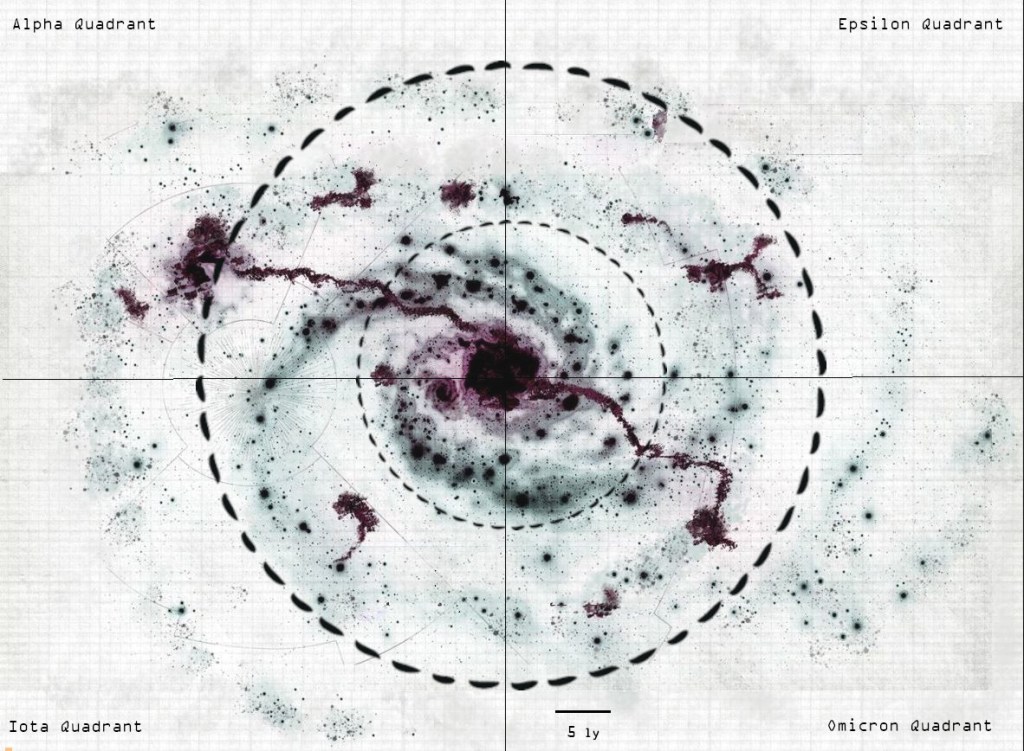
To assist with defining locations and mapping, the Unitarium designed naming conventions based on how the galaxy itself was classified. This classification divides the galaxy, accepted to be the shape of a sphere, into three separate layers―the Core, the Outer Rim, and the Waste, with the Core at the center and the Waste the most distance shell. The galaxy is also divided into four distinct quadrants―Alpha, Epsilon, Iota, and Omicron, the vowels of the Greek alphabet from old Earth.
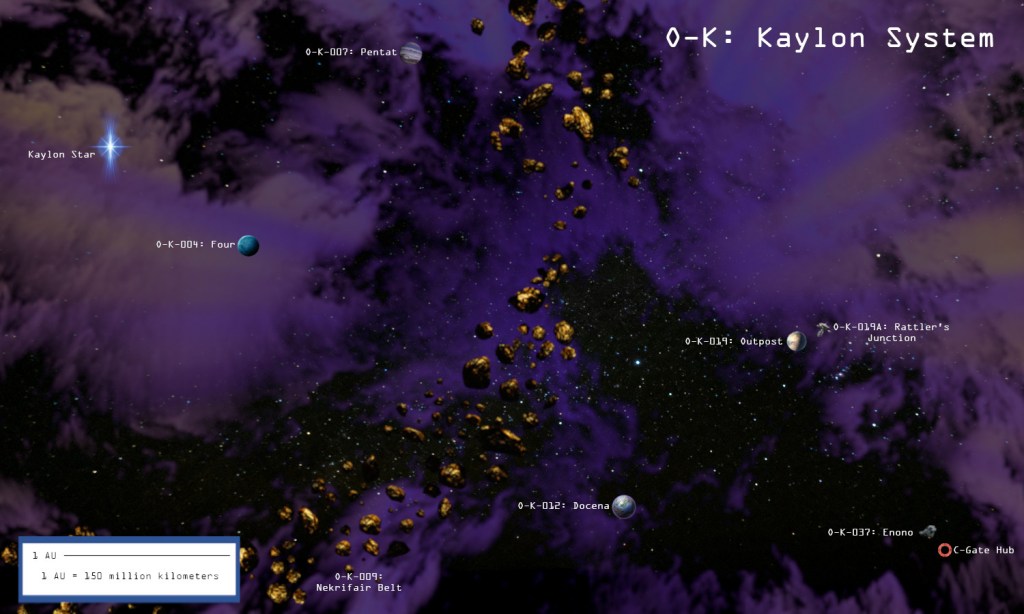
Each quadrant is further divided into systems, and the planets that fall within the confines of each system. The systems are named using the first letter of the consonants of the Greek alphabet, which limits each quadrant to twenty systems. The planets within each system are designated by a number, in sequential order based on the distance from the prevailing star of that system. For example, the Kaylon System is within the Omicron Quadrant, so all planets in that system are designated O-K-###, with “###” being that planet’s distance from the designated center of that system.
Omega from the Greek alphabet is not used in the naming, as it is reserved for the crystals that were discovered soon after the Gates, which make interstellar travel possible. The unique matrix that occurs naturally inside the crystals allows the proper focus of energy (solar) and can handle the load requirements to power StarDrives, the engines used in interstellar ships. Omega crystals are mined from different planets within the universe, usually found in large deposits. Most of the mining within the Core is controlled by the Unitarium, but those reserves are not limitless.
Tracking the passage of time was also modified by the Unitarium to create a uniform methodology known as system dates. It is not ideal for widespread use as the various planets take different amounts of time to complete one cycle around their resident star.
The date tracks the year, month, day, and portion of the day, based on the original Gregorian calendar of Earth. Systems dates are recorded as: SD YYYY/MM/DD.DD (SD stands for System Date; Y for year, M for month, and D for day). The day is recorded in a 24-hour format with minutes in hundredths. The time of 4:15 PM would be noted as 16.25 in this format. If a portion of the date is not needed, the numerical values are replaced with the letter representing the unnecessary component, such as the date the Gates were discovered as noted above.
Unitarium Galaxy
 WriteWorks